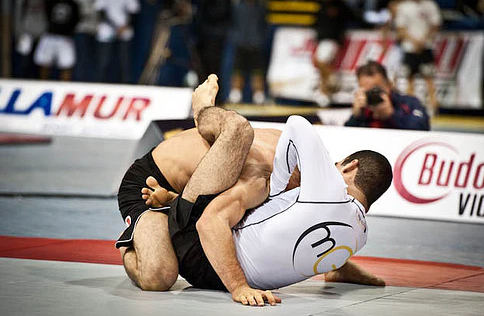
Overview
The high-elbow guillotine is a powerful no-gi strangle popularized by Marcelo Garcia and refined in modern grappling through systems such as those taught by John Danaher. It is characterized by the attacker lifting the non-strangle arm high—often referred to as the “Marcelotine” position—to close the space on the opponent’s far carotid artery while the strangle arm compresses the near side. This elevated elbow position creates a tight wedge around the opponent’s neck, dramatically increasing the strangling force.
The defining mechanic of the high-elbow guillotine is the upward flare of the secondary arm. By raising the elbow above the opponent’s back line, the attacker prevents the defender from passing to the non-strangle side, which is traditionally the safest escape route in standard guillotine variations.
This guillotine is commonly entered from front headlock exchanges, snap-downs, sprawls, and transitional moments where the opponent’s head is exposed. Because the finishing mechanics create such intense bilateral carotid compression, even small adjustments in wrist height, elbow angle, and hip alignment can produce immediate submissions. The high-elbow guillotine remains one of the most reliable and high-percentage strangling attacks in submission grappling.